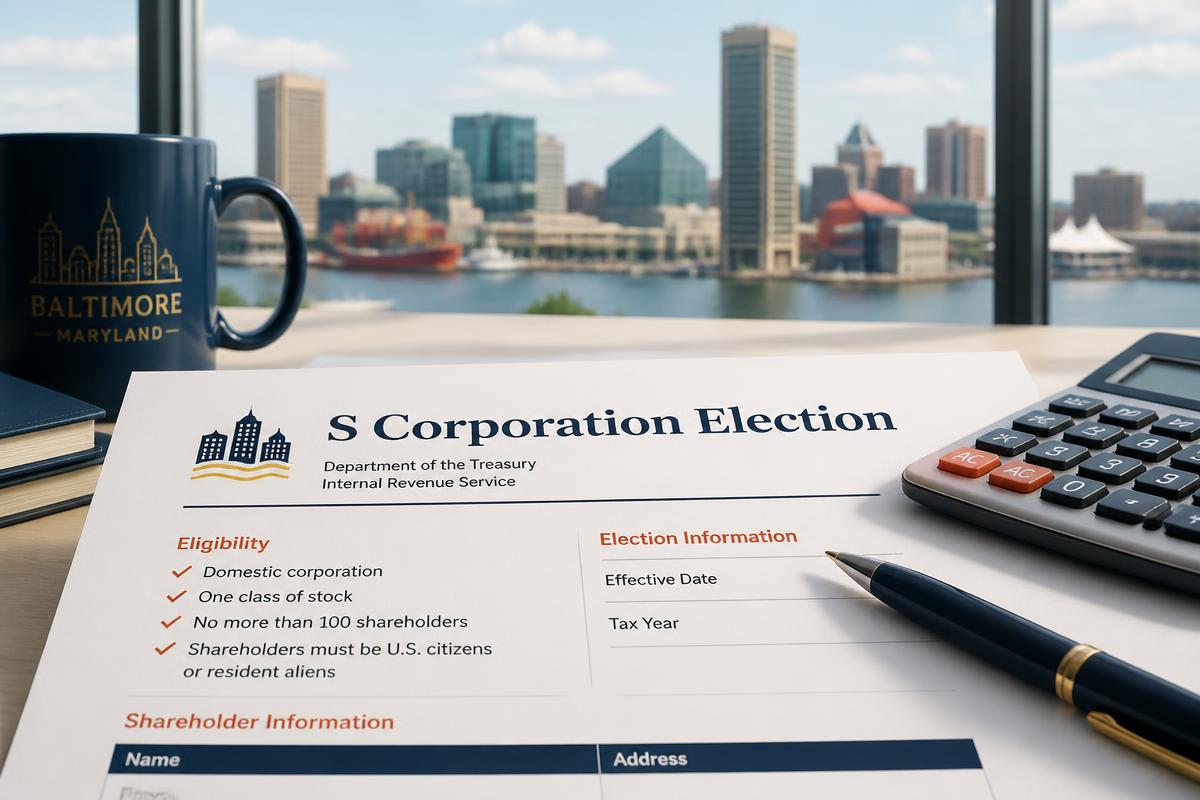
An S corporation is not a separate type of business entity. It is a federal tax election made by an existing corporation or LLC. Once the IRS approves the election, the business becomes a pass-through entity: profits and losses flow directly to the owners' personal tax returns, avoiding the double taxation faced by C corporations.
The structure is popular with small business owners who want the liability protection of a corporation or LLC combined with simpler tax treatment. But S-Corp status comes with strict IRS rules about shareholders, stock classes, and timing. If those rules are broken, the IRS can terminate the election and the business reverts to its original tax status.
Is an S corporation right for you?
An S-Corp election is often worth considering once your business is profitable enough to pay the owner a reasonable salary and still generate distributions. It can reduce self-employment taxes while preserving liability protection. It is also a common choice for consultants, professional service firms, and small family-owned businesses.
If you plan to raise venture capital, issue multiple classes of stock, or bring on many investors, an S-Corp will not fit. In those cases, a C corporation or LLC is usually the better path.
Advantages
Pass-through taxation
Profits and losses pass directly to shareholders' personal tax returns. This avoids the double taxation that affects C corporations.
Limited liability protection
Because an S-Corp begins as a corporation or LLC, owners generally keep their personal assets separate from business debts and liabilities.
Self-employment tax savings
Shareholders who work in the business can be paid a reasonable salary, with remaining profits distributed as distributions that are not subject to self-employment tax.
Credibility with customers and lenders
The corporate structure can make your business appear more established when applying for financing, contracts, or vendor accounts.
Disadvantages
Strict IRS ownership rules
S-Corps can have no more than 100 shareholders. Shareholders must be U.S. citizens or resident individuals, estates, or certain trusts — not partnerships or other corporations.
One class of stock
An S-Corp can only issue one class of stock, which limits flexibility in distributing profits or voting rights differently among owners.
More paperwork than an LLC
You must first form a corporation or LLC, then file IRS Form 2553. Ongoing corporate formalities like bylaws, meetings, and minutes may apply.
Reasonable salary requirement
The IRS requires shareholder-employees to be paid a reasonable salary before taking tax-free distributions, and that salary is subject to payroll taxes.
IRS requirements for S-Corp status
Domestic corporation or LLC
The business must be a domestic entity formed in the United States. Foreign entities cannot elect S-Corp status.
100 or fewer shareholders
An S-Corp cannot have more than 100 shareholders. Family members may be treated as one shareholder under certain rules.
Eligible shareholders only
Shareholders must be individuals who are U.S. citizens or residents, estates, or certain exempt organizations or trusts. Partnerships and corporations cannot be shareholders.
One class of stock
The business can only have one class of stock, although differences in voting rights are allowed as long as economic rights are identical.
Not an ineligible corporation
Certain businesses, including insurance companies, domestic international sales corporations, and financial institutions, are generally ineligible for S-Corp status.
How to elect S-Corp status in Maryland
- 1
Form a corporation or LLC first
An S-Corp is a tax election, not a standalone entity. You must first create a corporation or LLC with the Maryland Department of Assessments and Taxation (SDAT) through Maryland Business Express.
- 2
Get a federal EIN
Apply for a free Employer Identification Number from the IRS. You will need it for the S-Corp election, bank accounts, and tax filings.
- 3
Elect S-Corp status with the IRS
File IRS Form 2553, Election by a Small Business Corporation. For the election to take effect for the current tax year, most corporations must file within two months and 15 days of forming the entity.
- 4
Adopt an operating agreement or bylaws
Document ownership percentages, officer roles, profit distribution rules, meeting procedures, and how the company will maintain its S-Corp election.
- 5
Open a business bank account
Keep business funds completely separate from personal accounts. Bring your formation documents, EIN, and corporate resolution or operating agreement.
- 6
File Maryland taxes correctly
Maryland recognizes the federal S-Corp election. Shareholders report their share of income on their personal returns, and the business may owe Maryland pass-through entity tax or withholding depending on its structure.
- 7
Maintain corporate formalities
Hold annual meetings, keep minutes, file SDAT annual reports by April 15, and stay current on payroll and income taxes to preserve liability protection and S-Corp status.
Resources to help you decide
- IRS — S Corporations
Official IRS guidance on S-Corp eligibility, Form 2553 instructions, and tax filing requirements.
- IRS — Form 2553
Download the election form and instructions for choosing S corporation tax status.
- Maryland Business Express
Form your corporation or LLC, the first step before electing S-Corp status.
- Maryland SDAT — Charter Business Services
Filing forms, fees, name searches, and entity status lookups for Maryland businesses.
- IRS — Apply for an EIN
Free federal Employer Identification Number application, issued immediately online.
- Maryland Small Business Development Center
Free advising to help you decide if S-Corp status makes sense for your business and tax situation.
- SCORE Baltimore
Mentors who can review your S-Corp election and business structure decisions at no cost.
Ready to make it official?
Return to the full registration guide to form your entity, get your EIN, and file for the licenses Baltimore City requires.
Back to Register and License