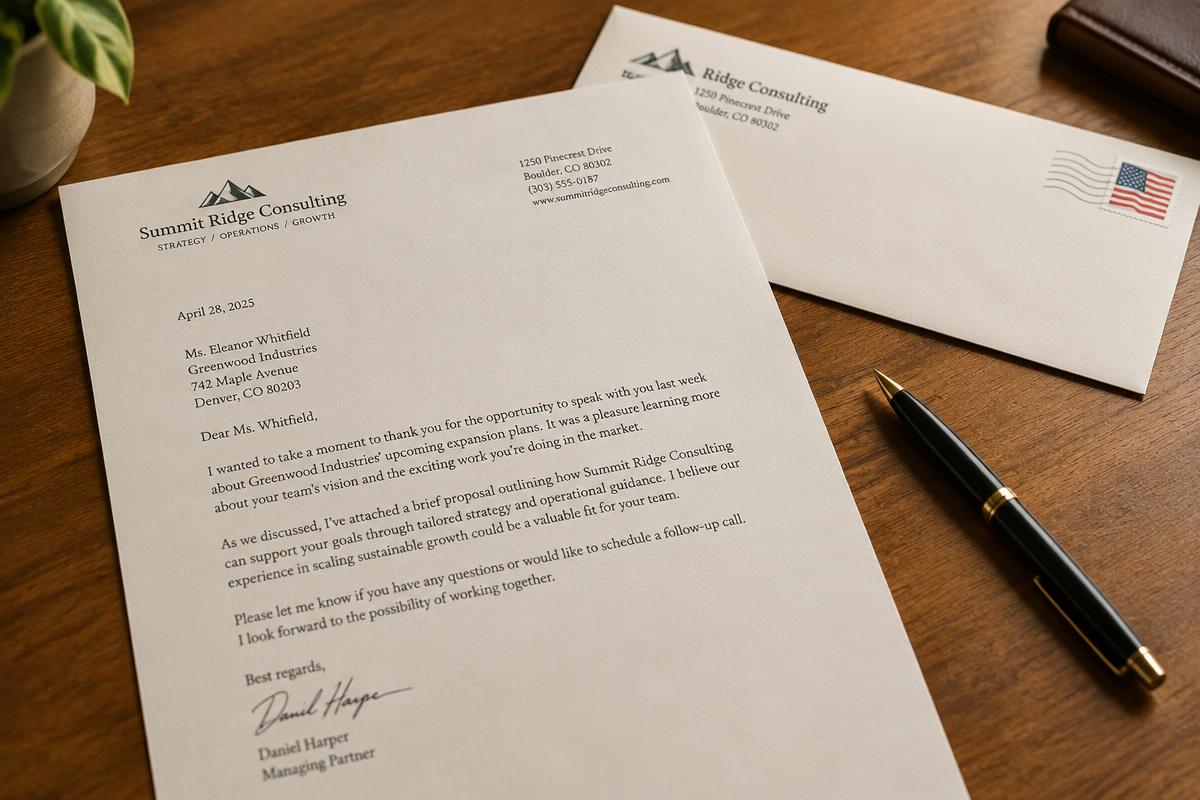
The six sections of a basic letter
Letters are one of the most important forms of business communication, covering everything from employment and application letters to claim letters and general information. Every letter includes six basic sections: heading, inside address, salutation, text, closing, and signature.
- The heading
- Your name, company name, and address. On letterhead stationery, simply add the date two lines below the letterhead. Avoid abbreviations, except for titles and state names.
- The inside address
- The addressee's name, title, and organization address. It appears four spaces below the heading, along the left margin.
- The salutation
- Used when you know the addressee's name and title. It begins with "Dear" and ends with a colon — Dear Dr. Smith: — If you are unsure of the name or title, or writing to several people, use an attention line instead: Attention: Theater Business Department.
- The text
- A brief introduction of no more than five lines identifying the writer and the issue; at least one body paragraph adding details and evidence; and a concluding paragraph that summarizes the main point and, if applicable, calls for action.
- The closing
- Two lines below the last paragraph, aligned with the salutation or attention line. Choose a closing that matches the formality of the letter — Respectfully, Sincerely, Cordially, Regards, or Best wishes — followed by a comma.
- The signature
- Four lines below the closing, including your typed name and title. Sign your name between the closing and the signature line.
Options below the signature
- If someone else types the letter, the typist adds his or her initials two spaces below the signature line, in lowercase, at the left margin after a slash: /ah or MB/ah.
- If you include documents, add an enclosure notice one space below the typist's initials or two spaces below the signature line: Enclosure, or Enclosures 2, or Encl. 5.
- For emphasis, list short titles for each enclosure: Enclosures: 3 copies of application, 1 proposal.
- Add a distribution notice (cc:) one space below any enclosure to show the letter is going to other readers.
- Use a postscript only to draw attention to a personal point — never to add something you forgot. If you forgot a point, rewrite the letter.
Keep in mind before you write
- To whom am I writing?
- What do I wish to achieve by writing this letter?
- What facts do I have?
- What does my reader need to know?
- What is my relationship with my reader?
Keep in mind for the final draft
- Have I proofread the material adequately?
- What impression do I make with this letter?
- How will my audience react to the letter?
Memos
Memos are the most common form of written communication inside a company. Thousands circulate daily, and most follow the same pattern so the writer can get to the point quickly.
- General format: To: / From: / Re: (regarding) or Subject: / Date:
- The text block carries the pertinent information, with headings and sub-headings if needed.
- Memos are short and precise — read and acted on quickly. In most cases keep a memo to one page, excluding enclosures.
- A memo can serve as an opening page, introduction, or abstract for a longer letter or report.
- Things to keep in mind: Is the memo concise? Is it clear?
An important reminder
- Memos are not used for information of a sensitive nature. If you must fire an employee, use more formal means.
Cover letters
Use appropriate stationery — company letterhead or your own personalized letterhead — and standard letter format. Cover letters serve a variety of purposes:
- Introduce you and/or your company
- Introduce the material that follows
- Include a short abstract for an informal report
- Present a questionnaire for further research
- Serve as confirmation of previous communication
- Outline a short proposal
- Include a contract or acceptance of contract
Most cover letters initiate further correspondence between parties. They are short, rarely more than one or two pages, and are recognized as more formal than memos or spoken arrangements. Salutations are formal — Mr. Hunter rather than Dear Adam.
Letters of recommendation
A well-written letter of recommendation can help an employee move successfully to another position. Most run about three paragraphs.
- First paragraph
- Mention your credentials and why you were asked to write the letter. Include the candidate's full name and the dates of employment.
- Second paragraph
- A short, detailed list of the applicant's work experience and responsibilities. Avoid flowery language and extreme phrases such as "Bill is the best worker we ever hired." Include general information about how the applicant functioned in the company — organizational skills, the ability to think independently, getting along with co-workers.
- Third paragraph
- End with insight into whether the applicant can take on the responsibilities of the new position. Do not overstate abilities.