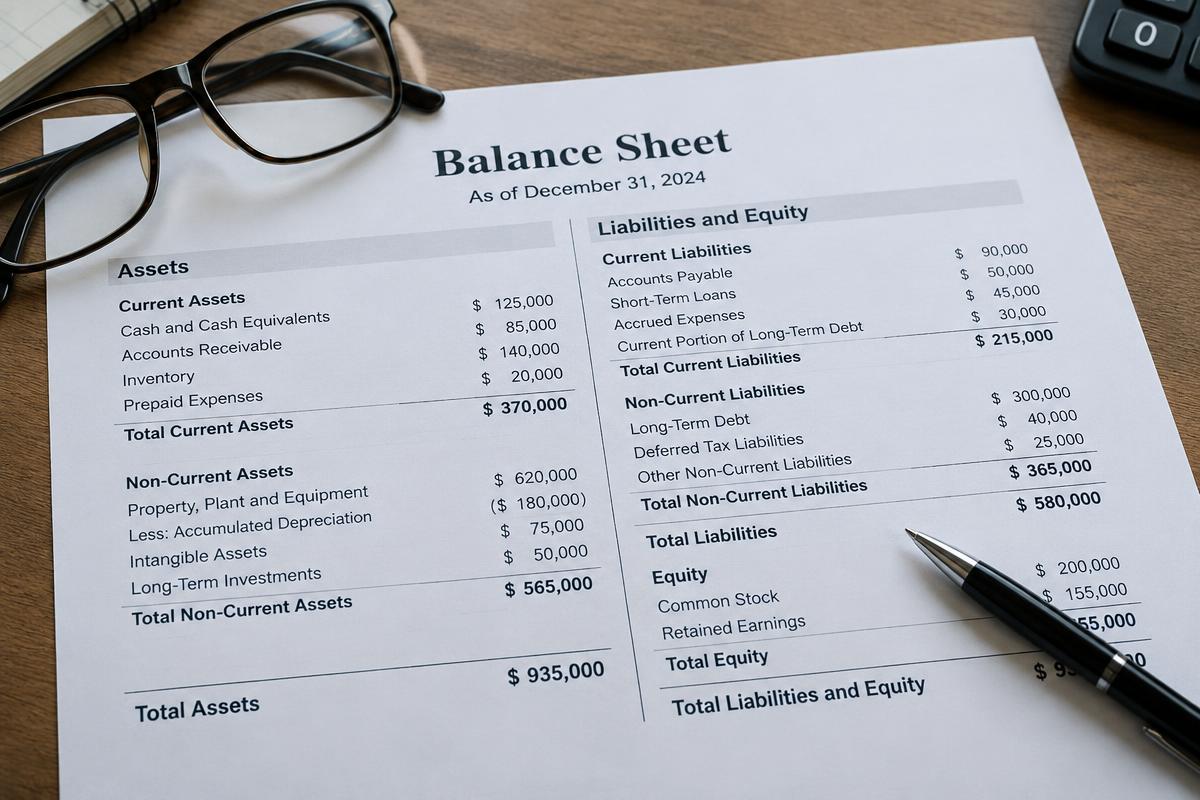
What the balance sheet shows
Also called the statement of financial position, it carries the name of the entity, the name of the statement, and an as-of date — for example, as of December 31, 20XX. It is a detailed presentation of the accounting equation and a snapshot of a business's financial position at a given point.
Formula
- Assets = Liabilities + Equity
- Assets are probable future economic benefits obtained or controlled by an entity as a result of past transactions or events (GAAP).
- As a general rule assets are valued at cost (historical cost), adjusted for depreciation or amortization on some assets.
- The cost principle generally prevents assets from being reported at more than cost. Conservatism may require assets to be reported at less than cost if there is a loss of value.
- A company's assets must equal — balance — its liabilities and equity.
- The statement shows account balances on the last day of the reporting period.
- A balance sheet can be analyzed using financial analysis tools such as ratios to determine financial health: liquidity and solvency.
- A balance sheet is included in annual reports to stockholders.
- It appears in government-required reports, such as the 10-K and regulatory reports required of banks (for example FDIC reporting).
- It appears in business plans, reports to the management team and directors, and financing requests.
Assets, liabilities, and shareholders' equity
- Assets
- Things a company owns that have value, which can be sold or used to make products or provide services that can be sold. Includes cash, investments, and tangible property such as buildings, trucks, equipment, and inventory, plus intangible things that have value, such as trademarks and patents.
- Liabilities
- Amounts of money a company owes to others — borrowings from a bank, rent for use of a building, money owed to suppliers, payroll owed to employees — including obligations to provide goods or services to customers in the future (unearned revenue).
- Shareholders' equity
- Also called capital or net worth: the money that would remain if a company sold all of its assets at their balance sheet values and paid off all of its liabilities. The leftover belongs to the shareholders, the owners of the company.
Current and noncurrent classifications
- Current assets
- Cash and other assets or resources reasonably expected to be realized in cash, sold, or consumed during the normal operating cycle of the business. Common current assets include cash, certain investments (trading, available-for-sale, and held-to-maturity securities), receivables, inventories, and prepaid expenses such as supplies, prepaid insurance, and prepaid rent. If the normal operating cycle is less than a year, one year is the period used.
- Noncurrent assets
- Assets that do not qualify as current, including investments intended to be held beyond one year or one operating cycle, such as the cash surrender value of life insurance policies.
- Property, plant and equipment (PP&E)
- Tangible operating assets: land, natural resources, buildings, equipment, furniture and fixtures, leasehold improvements, assets held under a capital lease, and noncurrent assets under construction.
- Other noncurrent assets
- Assets not classified elsewhere, such as bond issue costs, long-term prepayments, deferred tax assets, and long-term receivables such as loans to officers.
- Current liabilities
- Obligations whose liquidation is reasonably expected to require the use of existing resources classifiable as current assets, or the creation of other current liabilities. Includes trade payables (accounts payable) for materials and supplies used in producing goods or services; other payables such as interest, wages, salaries, rentals, and taxes payable; unearned revenues from cash collected in advance; and other payables due within a year of the ordinary operating cycle.
- Noncurrent liabilities
- Liabilities not qualifying as current: long-term notes and bonds, liabilities from capital leases, postretirement benefit obligations, deferred tax liabilities, and product or service warranty obligations.
Equity
Equity is the residual after total liabilities are subtracted from assets.
- Capital contributed by owners: in a corporation, the par value of common stock plus additional paid-in capital, and the par value of preferred stock plus paid-in capital.
- Retained earnings — normally the change for a period is Net Income – Dividends.
- Accumulated other comprehensive income: all comprehensive income items not included in net income.
- Treasury stock: the company's own stock that it has repurchased.
- Contra equity: represents a reduction in total equity.
- Noncontrolling interest in a consolidated entity.
| Line | Amount |
|---|---|
| Cash and cash equivalents | $300,000 |
| Trade receivables | 150,000 |
| Inventories | 140,000 |
| Other current assets | 15,000 |
| Total current assets | $605,000 |
| Furniture and fixtures | $550,000 |
| Leasehold improvements | 80,000 |
| Office equipment | 145,000 |
| Total noncurrent assets | 775,000 |
| Total assets | $1,380,000 |
| Trade and other payables | $200,000 |
| Short-term borrowings | 135,000 |
| Current portion of long-term borrowings | 5,000 |
| Current tax payable | 30,000 |
| Accrued expenses | 10,000 |
| Total current liabilities | $380,000 |
| Long-term debt | $85,000 |
| Deferred taxes | 20,000 |
| Total noncurrent liabilities | 105,000 |
| Total liabilities | $485,000 |
| Capital | $100,000 |
| Additional paid-in capital | 15,000 |
| Retained earnings | 780,000 |
| Total equity | $895,000 |
| Total liabilities and equity | $1,380,000 |