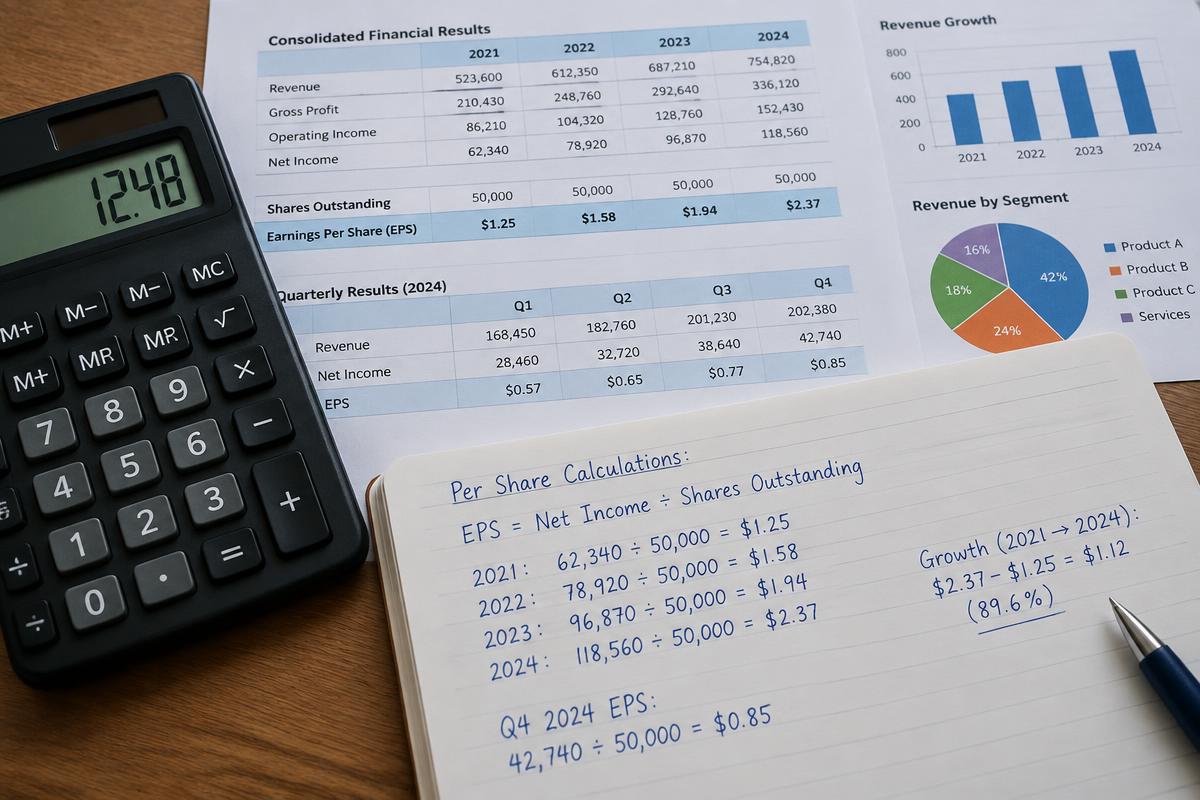
Earnings per share (EPS)
EPS is the current-period earnings associated with a single share of a corporation's stock.
- Two basic EPS amounts are reported on the face of an income statement: basic EPS for income from continuing operations, and basic EPS for net income.
- Income available to common stockholders is reduced by preferred dividends declared or accumulated in the current period.
- The weighted-average number of common shares outstanding is determined by the portion of time the shares were outstanding during the period.
Formula
- Basic EPS = Income available to common shareholders ÷ Weighted-average number of common shares outstanding
Worked example
Basic EPS
Income from continuing operations after deducting preferred dividends is $5,500,000 with 600,000 common shares outstanding. EPS: $5,500,000 ÷ 600,000 = $9.17 per share.
Diluted earnings per share (DEPS)
Diluted EPS is reported when a company has common stock plus securities outstanding such as preferred stock, convertible securities, options, and warrants. Dilution is a reduction in basic EPS resulting from an assumption that convertible securities are converted and that options and warrants are exercised.
- 1Add the number of potential shares that could be created by conversion of preferred shares or exercising stock rights to the weighted-average number of common shares outstanding.
- 2Add back the preferred dividends paid on any preferred shares that could be converted to the income available to shareholders.
- 3Add back the after-tax interest expense paid on any convertible bonds.
- 4Divide the income available to common shareholders by the new weighted average of shares outstanding to calculate diluted EPS.
Worked example
Diluted EPS, step by step
Step 1: the weighted-average number of common shares outstanding is 600,000. Preferred shares could be converted to 50,000 common shares, employees hold 20,000 shares of stock options, and convertible bonds can be redeemed for 30,000 common shares. Total potential shares = 700,000.
Step 2: the convertible preferred shares received $100,000 in dividends, and net income available to common shareholders is $5,500,000. $100,000 + $5,500,000 = $5,600,000.
Step 3: convertible bonds paid $100,000 in interest. $100,000 + $5,600,000 = $5,700,000.
Step 4: $5,700,000 ÷ 700,000 = $8.14 per share.
Cost of goods sold (COGS)
Cost of goods sold is a significant expense item for retailers, wholesalers, and manufacturers.
Formula
- Retailer or wholesaler COGS = Beginning Merchandise Inventory + Purchases – Ending Merchandise Inventory
- Manufacturer COGS = Beginning Finished Goods Inventory + Cost of Goods Manufactured – Ending Finished Goods Inventory
| Line | Amount |
|---|---|
| Beginning merchandise / finished goods inventory | $1,100,000 |
| Goods purchased / produced | 700,000 |
| Goods available for sale | $1,800,000 |
| Less: ending merchandise / finished goods inventory | 1,200,000 |
| Cost of goods sold | $600,000 |
Tip
- When calculating manufacturer COGS, include the costs of purchases, labor, materials, and other costs such as warehousing costs, packaging labor, and overhead expenses.
Cost of goods manufactured
Formula
- Cost of Goods Manufactured = Beginning Work in Process + Manufacturing Costs of the Period – Ending Work in Process
| Line | Detail | Total |
|---|---|---|
| Materials inventory, January 1, year 1 | $1,500,000 | |
| Purchases | $7,500,000 | |
| Less purchase returns and allowances | 50,000 | |
| Net purchases | 7,450,000 | |
| Materials available for use | 8,950,000 | |
| Less materials inventory, December 31, year 1 | 1,300,000 | |
| Direct materials used | $7,650,000 | |
| Direct labor | 6,400,000 | |
| Manufacturing overhead | $15,487,000 | |
| Total manufacturing cost | $29,537,000 | |
| Add work in process inventory, January 1, year 1 | 2,400,000 | |
| Total cost to be accounted for | $31,937,000 | |
| Less work in process, December 31, year 1 | 1,300,000 | |
| Cost of goods manufactured | $30,637,000 |
Manufacturing overhead in the example is made up of indirect labor $13,000,000, salaries $980,000, payroll taxes $490,000, heat $70,000, light $45,000, factory supplies $50,000, depreciation on the factory building $69,000, depreciation on machinery $404,000, repairs and maintenance $146,000, patent amortization $33,000, tools and dies used $178,000, and insurance on building and machinery $22,000.
Selling, general and administrative expenses
- Selling expenses
- Costs incurred in selling or marketing — for example sales representatives' salaries, commissions, advertising, ecommerce costs, and shipping costs.
- General and administrative expenses
- Costs incurred for the organization as a whole and not related to selling, marketing, or manufacturing — for example accounting, legal fees, officers' salaries, wages for office staff, insurance, and supplies expense.