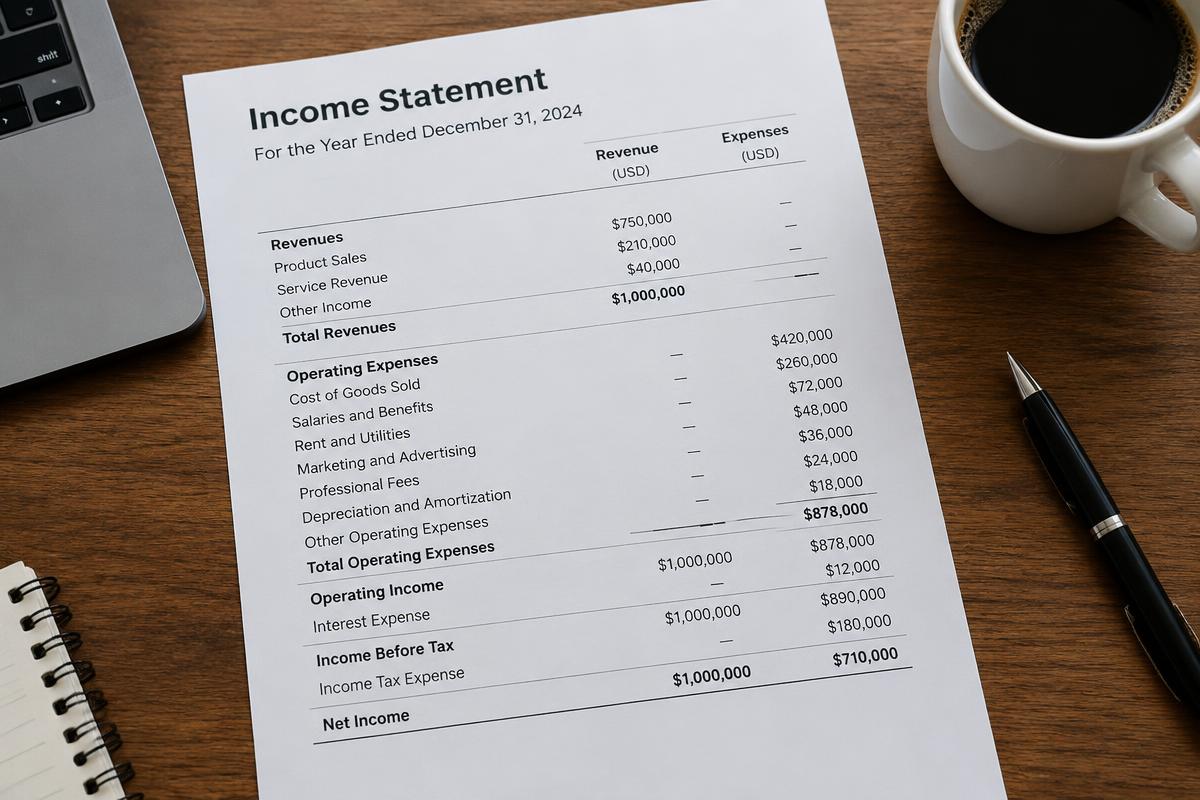
The statement of income
Also called the income statement, it shows the name of the entity, the name of the statement, and the span of time covered by the report — for example, for the year ended December 31, 20XX.
- Reveals how much revenue the company earned over a specific time period, usually a year or a portion of a year.
- Shows the costs and expenses associated with earning that revenue — the matching principle.
- The bottom line shows the company's net income or loss over the period.
- For a corporation, it also shows earnings per share (EPS) — how much shareholders would receive if the company distributed all of the net earnings for the period as dividends.
- Revenues and expenses are the result of the company's major activities; gains and losses come from other activities.
Formula
- Net Income (or Net Loss) = Revenues – Expenses + Gains – Losses
Preparing an income statement
- 1Always start with sales (revenues).
- 2Deduct cost of goods sold, also called cost of sales, to arrive at gross profit.
- 3Deduct operating expenses — the expenses that support operations for the period, such as administrative salaries and marketing and selling expenses. They differ from cost of goods sold because they cannot be linked directly to producing what is sold.
- 4Include depreciation as part of operating expenses: a cost allocation of tangible property over its useful life, accounting for wear and tear on machinery, tools, and furniture used over long periods.
- 5Subtract operating expenses from gross profit to arrive at operating profit before interest and income tax — also called income from operations.
- 6Add interest income and deduct interest expense to arrive at operating profit before income tax.
- 7Deduct income tax to arrive at net income or net loss.
Multiple-step income statement
- Operating revenues are shown separately from other revenues and gains.
- Operating expenses are shown separately from other expenses and losses.
- Matching operating revenues and gains results in operating income.
- Disclosure is enhanced by the use of many subtotals.
Formula
- Gross Profit = Net Sales – Cost of Goods Sold
- Income from Operations = Gross Profit – Total Operating Expenses
- Income Before Taxes = Income from Operations + Other Revenues and Gains – Other Expenses and Losses
- Net Income = Income Before Taxes – Income Taxes
| Line | Detail | Total |
|---|---|---|
| Gross sales | $3,000,000 | |
| Less: sales discounts | $300,000 | |
| Less: sales returns and allowances | 200,000 | 500,000 |
| Net sales | $2,500,000 | |
| Beginning inventory | $200,000 | |
| Purchases | 300,000 | |
| Less: purchase returns and allowances | 30,000 | |
| Net purchases | $270,000 | |
| Transportation-in | 20,000 | $290,000 |
| Goods available for sale | 490,000 | |
| Less: ending inventory | 90,000 | |
| Cost of goods sold | 400,000 | |
| Gross profit | $2,100,000 | |
| Selling expenses | $107,500 | |
| Administrative expenses | 142,500 | |
| Total operating expenses | $250,000 | |
| Income from operations | $1,850,000 | |
| Other revenues and gains | 250,000 | |
| Other expenses and losses | (20,000) | |
| Income before taxes | $2,080,000 | |
| Income taxes | (620,000) | |
| Net income | $1,460,000 | |
| Earnings per common share | $1.46 |
In the guide's example, selling expenses of $107,500 consist of sales salaries and commissions $100,000, freight-out $1,000, travel $2,000, advertising $3,000, and office supplies $1,500. Administrative expenses of $142,500 consist of executive salaries $100,000, professional salaries $30,000, wages $5,000, depreciation $2,500, and office supplies $5,000.
Single-step income statement
The single-step format provides one grouping for all revenues and gains and another for all expenses and losses. It is named single-step because there is one subtraction to derive net income.
| Line | Amount |
|---|---|
| Net sales | $2,500,000 |
| Other revenue | 200,000 |
| Gains | 50,000 |
| Total revenues and gains | $2,750,000 |
| Cost of goods sold | $400,000 |
| Selling and administrative expenses | 250,000 |
| Interest expense | 15,000 |
| Losses | 5,000 |
| Income tax expense | 620,000 |
| Total expenses and losses | $1,290,000 |
| Net income | $1,460,000 |
| Earnings per common share | $1.46 |
Condensed income statement
- A very common method of presentation in corporate annual reports.
- Includes only the section totals of the multiple-step format.
| Line | Amount |
|---|---|
| Net sales | $2,500,000 |
| Cost of goods sold | (400,000) |
| Gross profit | $2,100,000 |
| Selling expenses | $107,500 |
| Administrative expenses | 142,500 (250,000) |
| Income from operations | $1,850,000 |
| Other revenues and gains | 250,000 |
| Other expenses and losses | (20,000) |
| Income before taxes | $2,080,000 |
| Income taxes | (620,000) |
| Net income | $1,460,000 |
| Earnings per common share | $1.46 |
Guide: Financial Statements
NEXT · PART THREE: Earnings Per Share and Cost of Goods Sold
Continue the guide