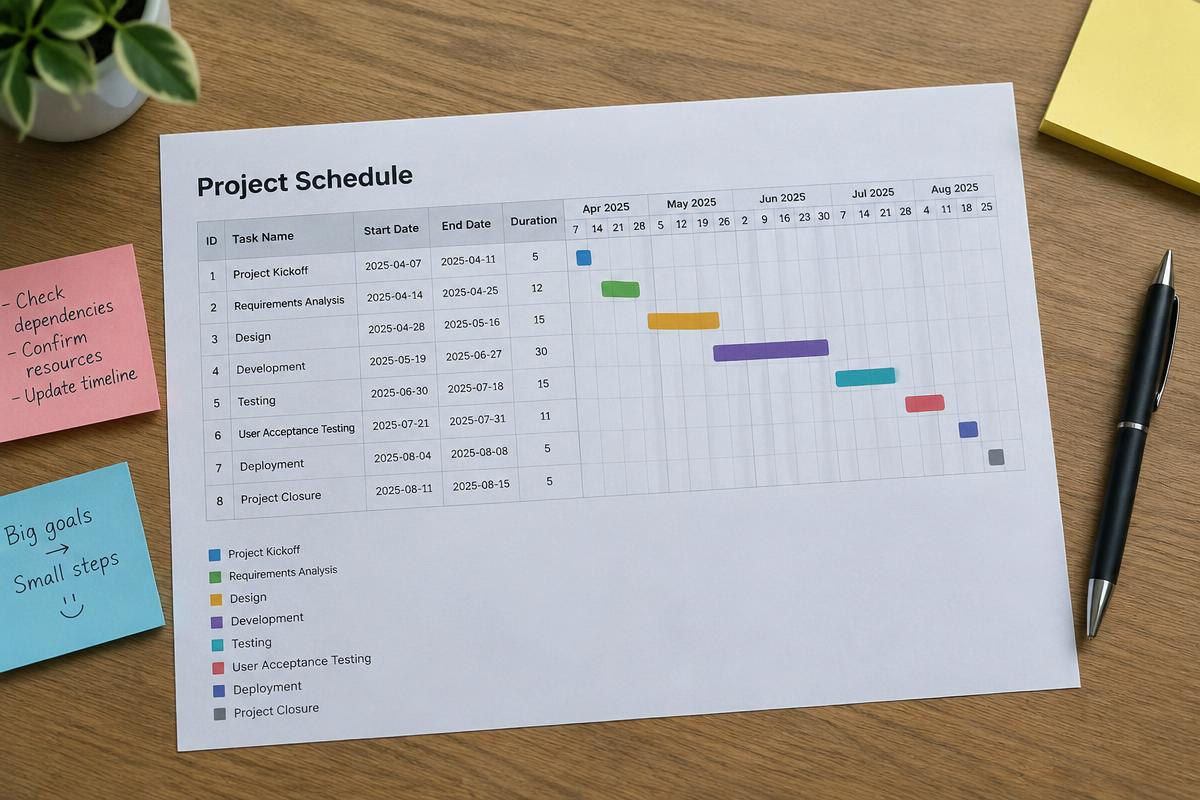
What a project is
A project is a temporary set of activities with a defined beginning and end, undertaken to meet specific scope, time, and cost goals. Opening a second location, installing new equipment, and launching a product are all projects.
- Scope goal
- The deliverables and the work required to produce them.
- Time goal
- The schedule — the date the project must be complete.
- Cost goal
- The budget for labor, materials, and outside services.
- Activity
- A task that consumes time and resources.
- Immediate predecessor
- The activity that must finish before a given activity can start.
Building the network
- 1List every activity needed to complete the project.
- 2Identify each activity's immediate predecessors.
- 3Estimate the duration of each activity.
- 4Draw the network showing the precedence relationships.
- 5Compute earliest and latest times, then the critical path.
- 6Use the schedule to assign resources and monitor progress.
- ES — earliest start
- The earliest an activity can begin: the largest EF of its predecessors.
- EF — earliest finish
- ES + activity duration.
- LF — latest finish
- The latest an activity can finish without delaying the project: the smallest LS of its successors.
- LS — latest start
- LF − activity duration.
- Slack
- LS − ES (equivalently LF − EF). Slack is the amount of delay an activity can absorb without pushing the project's finish date.
- Critical path
- The longest path through the network. Its activities have zero slack, and its length is the project duration.
Formula
EF = ES + tLS = LF − tSlack = LS − ES = LF − EFProject duration = length of the critical pathWorked example: critical path
Worked example
Seven-activity project
| Activity | Predecessor | Duration | ES | EF | LS | LF | Slack |
|---|---|---|---|---|---|---|---|
| A | — | 3 | 0 | 3 | 0 | 3 | 0 |
| B | A | 4 | 3 | 7 | 3 | 7 | 0 |
| C | A | 2 | 3 | 5 | 7 | 9 | 4 |
| D | B | 5 | 7 | 12 | 7 | 12 | 0 |
| E | C | 3 | 5 | 8 | 9 | 12 | 4 |
| F | D, E | 2 | 12 | 14 | 12 | 14 | 0 |
| G | F | 4 | 14 | 18 | 14 | 18 | 0 |
The critical path is A → B → D → F → G, and the project duration is 18 weeks. Activities C and E each carry 4 weeks of slack, so a short delay there costs nothing — a delay on the critical path delays the whole project.
CPM and PERT
CPM (Critical Path Method) assumes activity times are known with reasonable certainty. PERT (Program Evaluation and Review Technique) treats them as uncertain and uses three estimates for each activity.
Formula
Expected time t = (a + 4m + b) ÷ 6Variance v = [(b − a) ÷ 6]²where a = optimistic, m = most likely, b = pessimisticProject variance = sum of the variances of the critical-path activitiesWorked example
PERT estimate
An activity is estimated at 4 weeks optimistic, 6 weeks most likely, 14 weeks pessimistic.
Formula
t = (4 + 4(6) + 14) ÷ 6 = 42 ÷ 6 = 7 weeksv = [(14 − 4) ÷ 6]² = (1.667)² = 2.78Crashing the schedule
Crashing means paying to shorten activity durations. Two rules govern it.
- Only crash activities on the critical path — shortening an activity with slack changes nothing.
- Crash the critical activity with the lowest cost per period saved first, then recompute: the critical path can shift.
Formula
Crash cost per period = (Crash cost − Normal cost) ÷ (Normal time − Crash time)